


Bylaws
Corporate Governance Report
An Overview of Corporate Governance
The Company strives to maintain high level of corporate governance and has always adhered to excellent, prudent and efficient corporate governance principles and continuously improves its corporate governance methodology, regulates its operations, improves its internal control mechanism, implements sound corporate governance and disclosure measures, and ensures that the Company's operations are in line with the long-term interests of the Company and its shareholders as a whole. In 2020, the shareholders' meeting, the Board and the Supervisory Committee operated soundly and efficiently. The Company was dedicated to lean management while ensuring stable and healthy operation, and elevated its high-quality development to a new level, while continuously optimising its internal control system and comprehensive risk management in order to effectively ensure steady operation of the corporate. The standard of the Company's corporate governance continued to improve and is aligned with the long-term best interest of the shareholders, ensuring that the interests of the shareholders were effectively assured.
The Company persists in refining the basic system of its corporate governance. As a company incorporated in the People's Republic of China (the "PRC"), the Company adopts the Company Law of the People's Republic of China and other relevant laws and regulations as the basic guidelines for the Company's corporate governance. As a company dual-listed in Hong Kong and the United States, the Company strives to ensure compliance with the Rules Governing the Listing of Securities on The Stock Exchange of Hong Kong Limited (the "Listing Rules") and the regulatory requirements for non-US companies listed in the United States. In addition, the Company has regularly published statements relating to its internal control in accordance with the US Sarbanes-Oxley Act and the regulatory requirements of the SEC and the NYSE to confirm its compliance with related financial reporting, information disclosure, corporate internal control requirements and other regulatory requirements.
For the financial year ended 31 December 2020, the roles of Chairman and Chief Executive Officer of the Company were performed by the same individual. In the Company's opinion, through supervision by the Board of Directors (the "Board") and the Independent Non-Executive Directors of the Company, with effective control of the Company's internal check and balance mechanism, the same individual performing the roles of Chairman and Chief Executive Officer can enhance the Company's efficiency in decision-making and execution and effectively capture business opportunities. Many leading international corporations around the world also have similar arrangements. Save as stated above, the Company was in compliance with all the code provisions under the Corporate Governance Code as set out in Appendix 14 of the Listing Rules (the "Corporate Governance Code") in the year 2020.
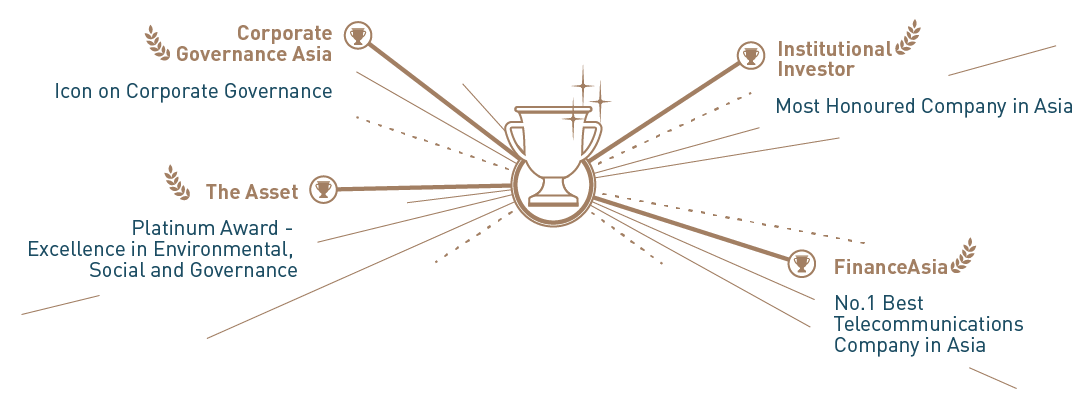
In 2020, the Company's continuous efforts in corporate governance gained wide recognition from the capital market and the Company was accredited with a number of awards. The Company was voted as the "Most Honoured Company in Asia" in the 2020 All-Asia-Executive-Team poll organised by Institutional Investor, a prestigious international financial magazine, for ten consecutive years. The Company also received "Best ESG", "Best IR Program" and other honours. The Company was accredited with "Platinum Award - Excellence in Environmental, Social and Governance" in the poll of ESG Corporate Awards 2020 by The Asset, and was the only telecommunications company in the region which had received the Platinum recognition for 12 years in a row. Mr. Ke Ruiwen, Chairman and CEO of the Company, was honoured with "Best CEO in Telecommunications" award while the Company was accredited "Best Investor Relations Team". In addition, the Company was awarded, for the 13th time, "The Best of Asia - Icon on Corporate Governance" by Corporate Governance Asia, a renowned regional journal on corporate governance. Mr. Ke Ruiwen, Chairman of the Company, was honoured with "Asia's Best CEO" and "Asian Corporate Director Recognition" awards. The Company was also accredited "No.1 Best Telecommunications Company in Asia" in Asia's Best Managed Companies Poll 2020 by FinanceAsia.
Overall Structure of the Corporate Governance
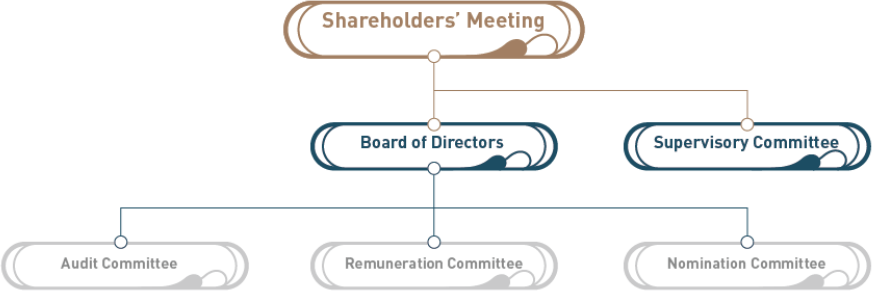
A two-tier structure is adopted as the overall structure for corporate governance: the Board and the Supervisory Committee are established under the shareholders' meeting; the Audit Committee, Remuneration Committee and Nomination Committee are established under the Board. The Board is authorised by the articles of association of the Company (the "Articles of Association") to make major operational decisions of the Company and to oversee the daily management and operations of the senior management. The Supervisory Committee is mainly responsible for the supervision of the performance of duties of the Board and the senior management. Each of the Board and the Supervisory Committee is independently accountable to the shareholders' meeting.
Shareholders' Meeting
In 2020, the Company convened one shareholders' meeting which was the annual general meeting for the year 2019 (the "2019 Annual General Meeting").
On 26 May 2020, the Company held the 2019 Annual General Meeting in Hong Kong to approve the following resolutions, all of which were duly passed and approved by the shareholders of the Company.
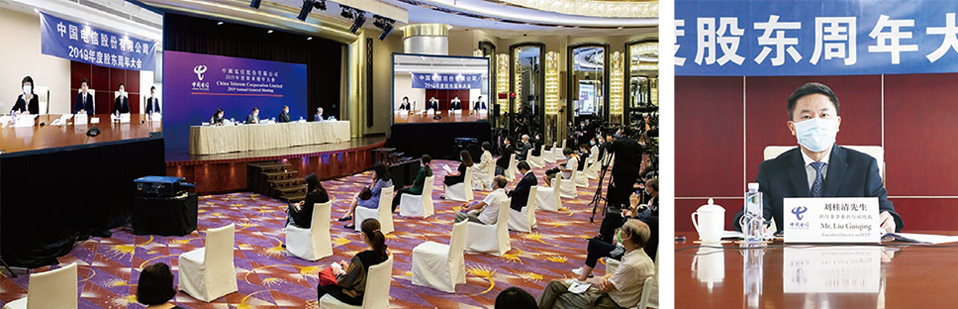
Since the Company's listing in 2002, at each of the shareholders' meetings, a separate shareholders' resolution was proposed by the Company in respect of each independent item. The circulars to shareholders also provided details of the resolutions. All votes on resolutions tabled at the shareholders' meetings of the Company were conducted by poll and all voting results were published on the websites of the Company and the Hong Kong Stock Exchange. The Company attaches great importance to the shareholders' meetings and the communication between Directors and shareholders. The Directors provided detailed and sufficient answers to the questions raised by shareholders at the shareholders' meetings. The Board implemented the Shareholders Communication Policy to ensure that the shareholders are provided with comprehensive, equal, understandable and public information of the Company on a timely basis and to facilitate the communication amongst the Company, the shareholders and investors.
Composition of Board of Directors and Board Diversity Policy
As at 31 December 2020, the Board consisted of 11 Directors with 6 Executive Directors, 1 Non-Executive Director and 4 Independent Non-Executive Directors. There is no relationship (including financial, business, family or other material or relevant relationship) among the Board members. The Audit Committee, Remuneration Committee and Nomination Committee under the Board consist solely of Independent Non-Executive Directors, which ensures that the Committees are able to provide sufficient checks and balances and make independent judgements to protect the interests of the shareholders and the Company as a whole. The number of Independent Non-Executive Directors exceeds one-third of the members of the Board. Mr. Tse Hau Yin, Aloysius, the Chairman of the Audit Committee, is an internationally renowned financial expert with extensive expertise in accounting and financial management. As at the date of this report, the Board comprised 10 Directors, including 5 Executive Directors, 1 Non-Executive Director and 4 Independent Non-Executive Directors. The term of office for the seventh session of the Board (including the Non Executive Directors) lasts for 3 years, starting from 26 May 2020 until the day of the Company's 2022 annual general meeting to be held in 2023, upon which the eighth session of the Board will be elected.
In August 2013, the Company implemented the Board Diversity Policy. The Company strongly believes that board diversity will contribute significantly to the enhancement of the overall performance of the Company. The Company views board diversity as the key element for accomplishing its strategic goals and sustainable development. In determining the composition of the Board, the Company takes into account diversity of the Board from a number of perspectives, including but not limited to gender, age, educational background, professional experience, skills, knowledge, duration of service and time commitment, etc. All appointments made or to be made by the Board are merit-based, and candidates are selected based on objective criteria taking full consideration of board diversity. Final decisions are comprehensively made based on each candidate's attributes and the consideration for his/her value contributions to be made to the Board. The Nomination Committee oversees the implementation of Board Diversity Policy, reviews the existing policy as and when appropriate, and recommends proposals for revisions for the Board's approval.
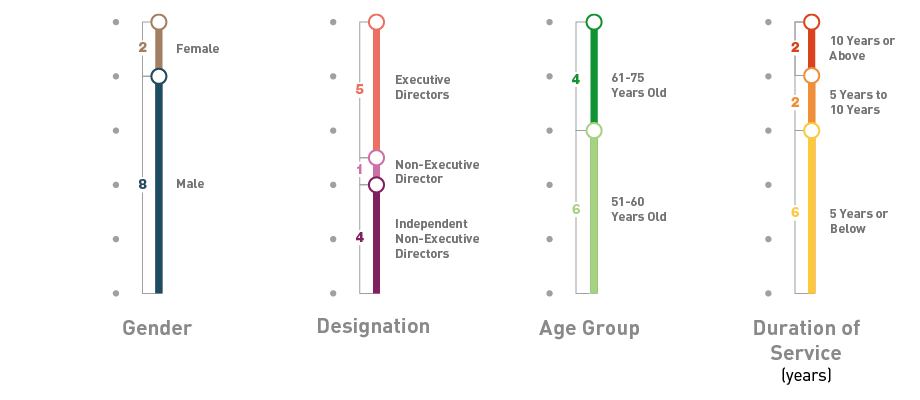
Biographical details of existing Directors are set out in the "Biographical details of Directors, Senior Management and Supervisors" section of this annual report. There are currently two female Directors on the Board. The Board currently comprises experts from diversified professions such as telecommunications, accounting, finance, law, banking, regulatory, compliance and management with diversification in terms of gender, age, duration of service, etc., advancing the enhancement of management standard and the further standardisation of corporate governance practices, which results in a more comprehensive and balanced Board structure and decision-making process. Each Director brings to the Board different views and perspectives. Both the Nomination Committee and the Board believe that the gender, age, educational background, professional experience, skills, knowledge and the duration of service of the Board members are in alignment with the Board Diversity Policy.
The below chart sets out the analysis of the Board composition as at the date of this report:
The Company strictly complies with the Corporate Governance Code to rigorously regulate the operating procedures of the Board and its Committees, and to ensure that the procedures of the Board meetings are in compliance with related rules in terms of organisation, regulations and personnel. The Board responsibly and earnestly supervises the preparation of financial statements for each financial period, so that such financial statements truly and fairly reflect the financial condition, the operating results and cash flows of the Company for such period. In preparing the financial statements for the year ended 31 December 2020, the Directors adopted appropriate accounting policies and made prudent, fair and reasonable judgements and estimates, and prepared the financial statements on a going concern basis.
The Articles of Association clearly defines the respective duties of the Board and the management. The Board is accountable to the shareholders' meetings, and its duties mainly include the execution of resolutions, formulation of major operational decisions, financial proposals and policies, formulation of the Company's basic management system and the appointment of senior management. The management is responsible for leading the production, operation and management of the Company, the implementation of Board resolutions and the annual operation plans and investment proposals of the Company, formulating the proposal of the Company's internal administrative organisations and sub organisations, and performing other duties as authorised by the Articles of Association and the Board. In order to maintain highly efficient operations, as well as flexibility and swiftness in operational decision-making, the Board may delegate its management and administrative powers to the management when necessary, and shall provide clear guidance regarding such delegation so as to avoid impeding or undermining the capabilities of the Board when exercising its powers as a whole.
All members of the Board and Committees are informed of the meeting schedule for the Board and Committees for the year at the beginning of each year. In addition, all Directors will receive meeting notice at least 14 days prior to the meeting under normal circumstances. The Company Secretary is responsible for ensuring that the Board meetings comply with all procedures, related rules and regulations while all Directors can make enquiries to the Company Secretary for details to ensure that they have received sufficient information on various matters set out in the meeting agendas.
The Board holds at least 4 meetings in each year. Additional Board meetings will be held in accordance with practical needs. In 2020, the Company convened 4 Board meetings in total and completed various written resolutions; the Chairman held a meeting to independently communicate with the Independent Non-Executive Directors without the presence of any other Directors to ensure their opinions can be fully expressed, which further facilitated the exchange of different views within the Board. In 2020, the Board played a pivotal role in the Company's operation, supervision, internal control, risk management and other significant decisions and corporate governance. Specifically, the Board reviewed matters including, but not limited to, the Company's annual and interim financial statements, quarterly financial results, risk management and internal control implementation and assessment report, annual proposal for profit distribution, amendments to the Articles of Association, approval and authorisation of the issuance of debentures, the budget of the Company for the years 2020 and 2021, review of the structure and operations of the Board, proposal for directors and senior management liabilities insurance, proposal for election or re-election of the Directors of the seventh session of the Board, election or re-election of the senior management, chairman and members of the Board Committees, remuneration proposal for the Directors of the seventh session of the Board, report on relevant situations under the global Epidemic environment, re-appointment and remuneration of auditors, and the progress report on the preparation of the Environmental, Social and Governance Report.
The Company determines the Directors' remuneration with reference to factors such as their respective duties and responsibilities in the Company, as well as their experience and market conditions at the relevant time.
The Board formulates and reviews the Company's policies and practices on corporate governance; reviews and monitors the training and continuous professional development of Directors and senior management; reviews and monitors the Company's policies and practices on compliance with legal and regulatory requirements; formulates, reviews and monitors the code of conduct for employees; and reviews the Company's compliance with the Corporate Governance Code and disclosure in the Corporate Governance Report.
Directors' Training and Continuous Professional Development
The Company provides guidelines including on directors' duties, continuing obligations, relevant laws and regulations, operation and business of the Company to newly appointed Directors so that they are provided with tailored induction relating to their appointment. To ensure that the Directors are familiar with the Company's latest operations for decision making, the Company arranges for key financial data and operational data to be provided to the Directors on a monthly basis. Meanwhile, through regular Board meetings and reports from management, the Directors are able to have clearer understanding of the operations, business strategy, and the latest development of the Company and the industry. In addition, the Company reminds the Directors of their functions and duties by continuously providing them with information regarding the latest development of the Listing Rules and other applicable regulations, and arranging internal training on topics related to the latest development of the industry and operational focus of the Company for mutual exchange of ideas and discussion. The Directors actively participate in training and continuous professional development to develop and refresh their knowledge and skills in order to contribute to the Company.
During the year, the Directors have participated in training and continuous professional development activities, and the summary is as follows:
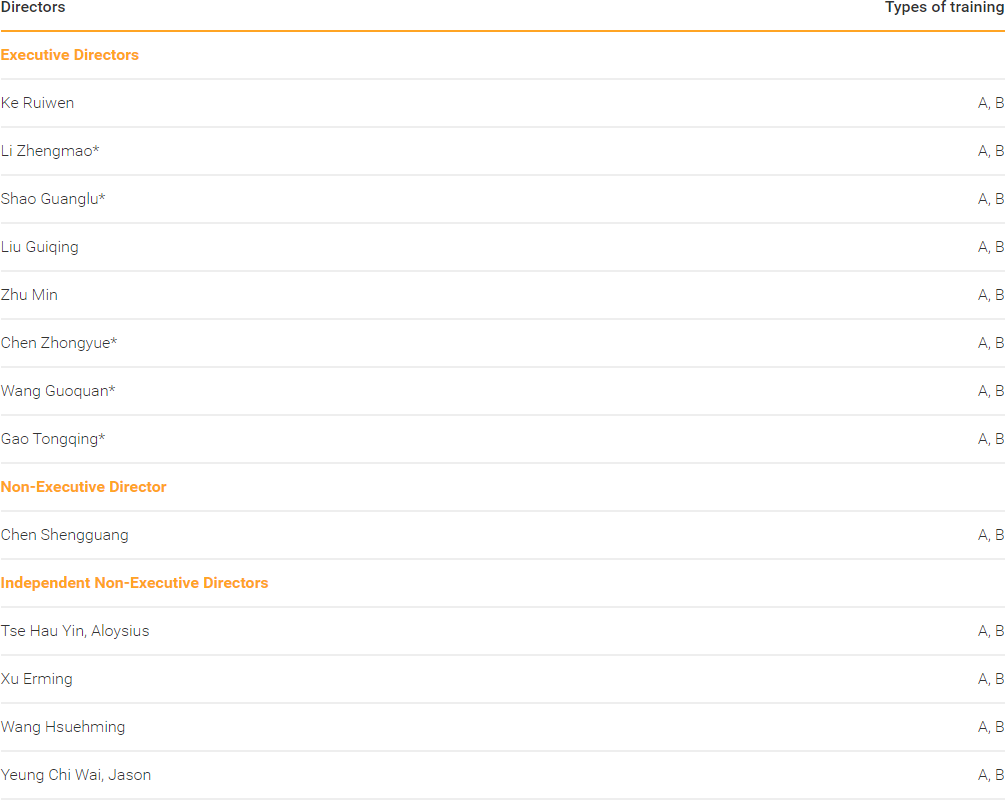
A: attending relevant seminars and/or conferences and/or forums; or delivering speeches at relevant seminars and/or conferences and/or forums
B: reading or writing relevant newspapers, journals and articles relating to economy, general business, telecommunications, corporate governance or directors' duties
* On 17 January 2020, Mr. Gao Tongqing resigned from his positions as an Executive Director and Executive Vice President of the Company due to change in work arrangement. On 26 May 2020, Mr. Li Zhengmao and Mr. Shao Guanglu were appointed as Directors at the 2019 Annual General Meeting. On 4 December 2020, Mr. Wang Guoquan resigned from his positions as an Executive Director and Executive Vice President of the Company due to change in work arrangement. On 19 January 2021, Mr. Chen Zhongyue resigned from his positions as an Executive Director and Executive Vice President of the Company due to change in work arrangement.
Compliance with the Model Code for Securities Transactions by Directors and Supervisors and Confirmation of Independence by the Independent Non Executive Directors
The Company has adopted the Model Code for Securities Transactions by Directors of Listed Issuers as set out in Appendix 10 of the Listing Rules to govern securities transactions by the Directors and Supervisors. Based on the written confirmation from the Directors and Supervisors, the Company's Directors and Supervisors have strictly complied with the Model Code for Securities Transactions by Directors of Listed Issuers in Appendix 10 of the Listing Rules regarding the requirements in conducting securities transactions for the year 2020. Meanwhile, the Company has received annual independence confirmation from each of the Independent Non-Executive Directors and considered them to be independent.
Audit Committee
As at 31 December 2020, the Audit Committee comprised 4 Independent Non-Executive Directors, Mr. Tse Hau Yin, Aloysius as the Chairman and Mr. Xu Erming, Madam Wang Hsuehming and Mr. Yeung Chi Wai, Jason as the members. The Audit Committee is responsible to the Board. The Charter of the Audit Committee clearly defines the status, structure and qualifications, work procedures, duties and responsibilities, funding and remuneration, etc. of the Audit Committee. The Audit Committee's principal duties include the supervision of the truthfulness and completeness of the Company's financial statements, the effectiveness and completeness of the Company's internal control and risk management systems as well as the work of the Company's Internal Audit Department. It is also responsible for the supervision and review of the qualifications, selection and appointment, independence and services of external independent auditors. The Audit Committee ensures that the management has discharged its duty to establish and maintain an effective risk management and internal control system including the adequacy of resources, qualifications and experience of staff fulfilling the accounting, internal control and financial reporting functions of the Company together with the adequacy of the staff's training programmes and the related budget. The Audit Committee also has the authority to set up a reporting system on whistleblowing to receive and handle cases of complaints or complaints made on an anonymous basis regarding the Company's accounting, internal control and audit matters. Any complaints on the aforementioned subject matters can be submitted by post (31 Jinrong Street, Xicheng District, Beijing 100033, China) or phone (86-18911351635).The Audit Committee is responsible to and regularly reports its work to the Board.
In 2020, pursuant to the requirements of the governing laws and regulations of the places of listing and the Charter of the Audit Committee, the Audit Committee fully assumed its responsibilities within the scope of the clear mandate from the Board. The Audit Committee proposed a number of practical and professional recommendations for improvement based on the Company's actual circumstances in order to promote the continuous improvement and perfection of corporate management. The Audit Committee has provided important support to the Board and played a significant role in protecting the interests of the independent shareholders.
In 2020, the Audit Committee convened 4 meetings and passed 2 written resolutions, in which it reviewed matters including but not limited to, the Company's annual and interim financial statements and quarterly financial results, assessment of the qualifications, independence and performance, appointments and remuneration of the external auditors, effectiveness of risk management and internal control systems, internal audit, implementation of continuing connected transactions, selection of external auditors, the progress work report of the change of external auditors, review of the operations in 2019 and the Charter of the Audit Committee, and the progress report on the preparation of the Environmental, Social and Governance Report. The Audit Committee reviewed the annual auditor's report, interim review report and quarterly agreed-upon procedures reports prepared by the external auditors, communicated with the management and the external auditors in regard to the regular financial reports and proposed them for the Board's approval after review and approval. The Audit Committee regularly received quarterly reports in relation to the internal audit and continuing connected transactions and provided guidance to the Internal Audit Department. Additionally, the Audit Committee reviewed the internal control assessment and the attestation report, followed up with the implementation procedures of the recommendations proposed by the external auditors, reviewed the U.S. annual report, and communicated independently with the external auditors twice a year.
Remuneration Committee
As at 31 December 2020, the Remuneration Committee comprised 3 Independent Non-Executive Directors, Mr. Xu Erming as the Chairman and Mr. Tse Hau Yin, Aloysius and Madam Wang Hsuehming as the members. The Remuneration Committee is responsible to the Board. The Charter of the Remuneration Committee clearly defines the status, structure and qualifications, work procedures, duties and responsibilities, funding and remuneration, etc. of the Remuneration Committee. The Remuneration Committee assists the Board to formulate overall remuneration policy and structure for the Company's Directors and senior management, and to establish related procedures that are standardised and transparent. The Remuneration Committee's principal duties include giving recommendations to the Board in respect of the overall remuneration policy and structure for the Company's Directors and senior management and the establishment of a formal and transparent procedure for developing remuneration policy, and determining, with delegated responsibility by the Board, the remuneration packages of individual Executive Directors and senior management including benefits in kind, pension rights and compensation payments (including any compensation payable for loss or termination of their office or appointment). Its responsibilities comply with the requirements of the Corporate Governance Code. The Remuneration Committee convened 1 meeting in 2020, during which it reviewed and discussed the remuneration proposals for the Directors of the seventh session of the Board.
Nomination Committee
As at 31 December 2020, the Nomination Committee comprised 3 Independent Non-Executive Directors, Madam Wang Hsuehming as the Chairlady and Mr. Tse Hau Yin, Aloysius and Mr. Xu Erming as the members. The Nomination Committee is responsible to the Board. The Charter of the Nomination Committee clearly defines the status, structure and qualifications, work procedures, duties and responsibilities, funding and remuneration, etc. of the Nomination Committee, and it specifically requires that the Nomination Committee members shall have no significant connection with the Company, and comply with the regulatory requirements related to "independence". The Nomination Committee assists the Board to formulate standardised, prudent and transparent procedures for the appointment and succession plans of Directors, and to further optimise the composition of the Board. The principal duties of the Nomination Committee include regularly reviewing the structure, number of members, composition and diversity of the Board; identifying candidates and advising the Board with the appropriate qualifications for the position of Directors; reviewing the Board Diversity Policy as appropriate to ensure its effectiveness; evaluating the independence of Independent Non-Executive Directors; advising the Board on matters regarding the appointment or re-appointment of Directors and succession plans for the Directors (especially Chairman and Chief Executive Officer). The Nomination Committee convened 1 meeting in 2020, during which it performed a review of the structure and operations of the Board and considered the recommendation of the proposed candidates for the Directors of the seventh session of the Board.
Number of Board and Committee Meetings Attended/Held in 2020
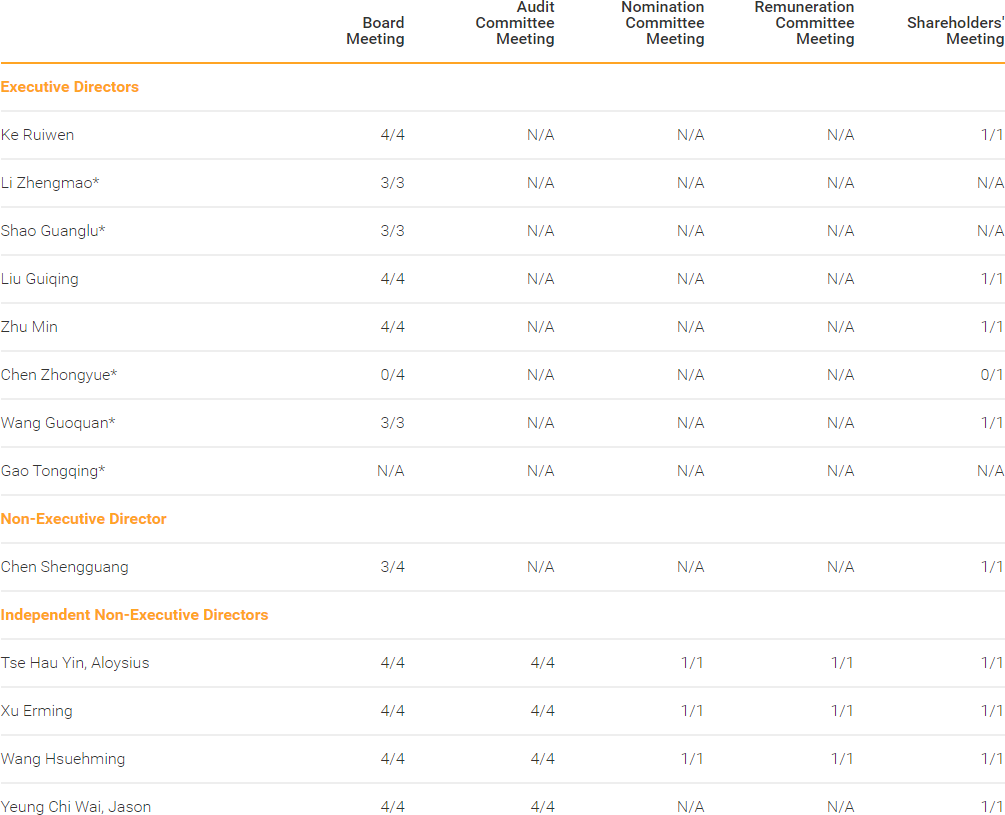
| Note: | Certain Directors (including Non-Executive Director) could not attend some of the shareholders' meetings and Board meetings due to other important business commitments. Such Directors have reviewed the relevant Board meeting agendas and papers before the meetings and authorised other Directors in writing to vote on their behalf so as to ensure their views were fully reflected in the meetings. |
| * | On 17 January 2020, Mr. Gao Tongqing resigned from his positions as an Executive Director and Executive Vice President of the Company due to change in work arrangement. On 26 May 2020, Mr. Li Zhengmao and Mr. Shao Guanglu were appointed as Directors at the 2019 Annual General Meeting. On 4 December 2020, Mr. Wang Guoquan resigned from his positions as an Executive Director and Executive Vice President of the Company due to change in work arrangement. On 19 January 2021, Mr. Chen Zhongyue resigned from his positions as an Executive Director and Executive Vice President of the Company due to change in work arrangement. |
The Company will identify suitable Director candidates through multiple channels such as internal recruitment and recruiting from the labour market. The criteria of identifying candidates include but not limited to their gender, age, educational background, professional experience, skills, knowledge and length of service and capability to commit to the affairs of the Company and, in the case of Independent Non-Executive Director, the candidates should fulfill the independence requirements set out in the Listing Rules from time to time. After the Nomination Committee and the Board have reviewed and resolved to appoint the appropriate candidate, the relevant proposal will be put forward in writing to the shareholders' meeting for approval.
Directors shall be elected at the shareholders' meeting for a term of 3 years. At the expiry of a Director's term, the Director may stand for re-election and re appointment. According to the Articles of Association, before the convening of the annual general meeting, shareholders holding 3% or more of the total voting shares of the Company shall have the right to propose new motions (such as election of Directors) in writing, and the Company shall place such proposed motions on the agenda for such annual general meeting if there are matters falling within the functions and powers of shareholders in general meetings. According to the Articles of Association, shareholders can also request for the convening of extraordinary general meeting provided that 2 or more shareholders holding in aggregate 10% or more of the shares carrying the right to vote at the meeting sought to be held and they shall sign one or more written requisitions in the same format and with the same content, requiring the Board to convene an extraordinary general meeting and stating the resolutions of meeting (such as election of Directors). The Board shall convene an extraordinary general meeting within 2 months. The minimum period during which written notice given to the Company of the intention to propose a person for election as a Director, and during which written notice to the Company by such person of his/her willingness to be elected may be given, will be at least 7 days. Such period will commence no earlier than the day after the despatch of the notice of the meeting for the purpose of considering such election and shall end no later than 7 days prior to the date of such meeting. The ordinary resolutions to approve the appointment of Directors shall be passed by votes representing more than one-half of the voting rights represented by the shareholders (including proxies) present at the meeting.
Supervisory Committee
As at 31 December 2020, the Company's Supervisory Committee comprised 5 Supervisors, including 2 Employee Representative Supervisors. The principal duties of the Supervisory Committee include supervising, in accordance with the law, the Company's financials and performance of its Directors, managers and other senior management so as to prevent them from abusing their powers. The Supervisory Committee is a standing supervisory organisation within the Company, which is accountable to and reports to all shareholders. The Supervisory Committee usually holds meetings at least twice a year. The Supervisory Committee convened 2 meetings in 2020. The term of office for the seventh session of the Supervisory Committee lasts for 3 years, starting from 26 May 2020 until the day of the 2022 annual general meeting to be held in year 2023, upon which the eighth session of the Supervisory Committee will be elected.
Number of Supervisory Committee Meetings Attended/Held in 2020
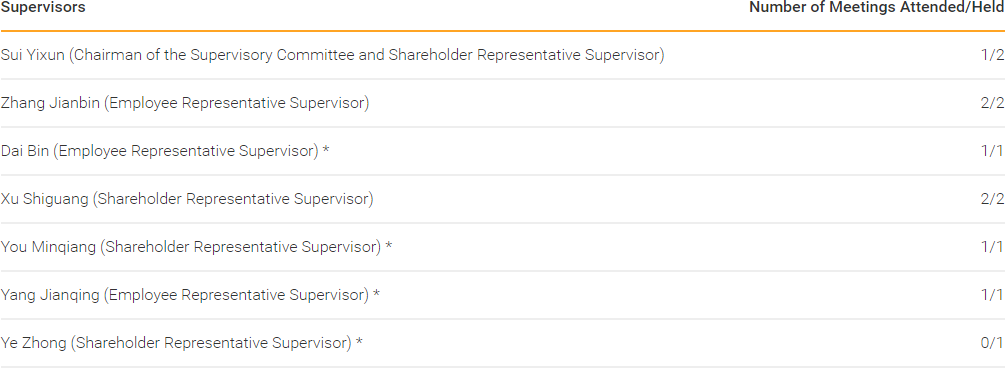
| Note: | Certain Supervisors could not attend some of the meetings of the Supervisory Committee due to other important business commitments. |
| * | On 26 May 2020, Mr. You Minqiang was appointed as Shareholder Representative Supervisor at the 2019 Annual General Meeting. Meanwhile, Mr. Dai Bin has been elected by the employees of the Company democratically as the Employee Representative Supervisor. Due to their age, Mr. Yang Jianqing, an Employee Representative Supervisor of the sixth session of the Supervisory Committee, and Mr. Ye Zhong, a Shareholder Representative Supervisor of the sixth session of the Supervisory Committee, retired from their positions as Supervisors of the Company upon the expiry of their term of office at the 2019 Annual General Meeting. |
External Auditors
The international and domestic auditors of the Company are Deloitte Touche Tohmatsu and Deloitte Touche Tohmatsu Certified Public Accountants LLP, respectively. The non-audit services provided by the external auditors did not contravene the requirements of the US Sarbanes-Oxley Act and therefore enabling them to maintain the independence.
A breakdown of the remuneration received by the external auditors for audit and non-audit services provided to the Company for the year ended 31 December 2020 is as follows:

The Directors of the Company are responsible for the preparation of consolidated financial statements that give a true and fair view in accordance with the International Financial Reporting Standards as issued by the International Accounting Standards Board and the disclosure requirements of the Hong Kong Companies Ordinance, and for such internal control as the Directors determine is necessary to enable the preparation of consolidated financial statements that are free from material misstatement, whether due to fraud or error. The Directors were not aware of any material uncertainties relating to any events or conditions which may cast a serious impact upon the Group's ability to continue as a going concern. The statements by the external auditors of the Company, Deloitte Touche Tohmatsu, regarding their reporting responsibilities on the consolidated financial statements of the Company is set out in the Independent Auditor's Report on pages 160 to 163 of this annual report.
Since the approval at the annual general meeting of the Company for the year 2012, the external auditors, Deloitte Touche Tohmatsu and Deloitte Touche Tohmatsu Certified Public Accountants LLP have provided audit services for the Company for eight consecutive years. Pursuant to the relevant regulations issued by the Ministry of Finance of the People's Republic of China and SASAC, the service term of Deloitte Touche Tohmatsu and Deloitte Touche Tohmatsu Certified Public Accountants LLP will expire soon. They will retire as the international auditors and domestic auditors of the Company effective upon the close of the forthcoming annual general meeting of the Company for the year 2020 and will not be re appointed. Pursuant to the open selection process, and as recommended by the Audit Committee of the Company, the Board has resolved to propose for the shareholders' approval for the appointment of PricewaterhouseCoopers and PricewaterhouseCoopers Zhong Tian LLP as the Company's external auditors for the year ending 31 December 2021 at the 2020 Annual General Meeting.
Risk Management and Internal Control System
The Board attaches great importance to the establishment and perfection of the risk management and internal control systems. The Board is responsible for evaluating and determining the nature and extent of the risks it is willing to take in achieving the Company's strategic objectives, and ensuring that the Company establishes and maintains appropriate and effective risk management and internal control systems, and the Board acknowledges that it is responsible for the risk management and internal control systems and for reviewing their effectiveness. Such systems are designed to manage rather than eliminate the risk of failure to achieve business objectives, and can only provide reasonable but not absolute assurance against material misstatements or losses. The Board oversees management in the design, implementation and monitoring of the risk management and internal control systems. The Board takes effective approaches to supervise the implementation of related control measures, whilst enhancing operation efficiency and effectiveness, and optimising corporate governance, risk assessment, risk management and internal control so that the Company can achieve long-term development goals.
The risk management and internal control systems of the Company is built on clear organisational structure and management duties, an effective delegation and accountability system, definite targets, policies and procedures, comprehensive risk assessment and management, a sound financial accounting system, and continuing analysis and supervision of operational performance, etc. which plays a pivotal role in the Company's overall operation. The Company has formulated a code of conduct for the senior management and employees which ensures their ethical value and competency. The Company attaches great importance to the prevention of fraud and has formulated its internal reporting system, which encourages anonymous reporting of situations where employees, especially Directors and senior management, breach the rules.
The Company views comprehensive risk management as an important task within the Company's daily operation. Pursuant to regulatory requirements in capital markets of the United States and Hong Kong, the Company has formulated a featured 5-step risk management approach based on risk management theory and practice to achieve closed-loop management of risk identification, risk assessment, key risk analysis, risk reaction and risk management assessment. In continuously strengthening the risk process control and management and focusing on significant risk which may be encountered, the Company established a risk monitoring team, to follow and report the status of risk management and control regularly, improve the collection mechanism of risk-related information and identify the potential flaws of risk in a timely manner. Following the efforts made over the years, the Company has established a structured and highly effective comprehensive risk management system and has gradually perfected its comprehensive risk monitoring and prevention mechanism.
In 2020, pursuant to the requirement of code provision C2 of the Corporate Governance Code promulgated by the Hong Kong Stock Exchange, the Company concentrated resources on the prevention of significant potential risks, and strived to reduce negative effect from significant risks. The Company was not confronted by any major risk event throughout the whole year.
The Company has identified, assessed and analysed potential major risks faced by the Company in 2021, including economic and policy environment adaptation risks, business development risks and network and information security risks etc., and has put forward detailed response plans. Through strict and appropriate risk management procedures, the Company will ensure the potential impact from the above risks on the Company is limited and within an expected range.
In 2021, the potential significant risks and the major risk prevention and countering measures are as follows:
Economic and policy environment adaptation risks: Facing the risks and challenges, such as the increasing uncertainties in the economy development, the wide ranging impact of the global COVID-19 Epidemic, the gradual impacts of regulatory policies' adjustments in the industry, the official commencement of the 5G era, and the apparent increase in the sources of global unrest and risks, the Company will actively respond to the change in environment, implement the requirements of regulatory policies, accelerate the construction of information infrastructure represented by 5G, innovate 5G applications and business models, deepen reform and innovation, expedite "Cloudification and Digital Transformation", expand ecological cooperation, perfect overseas compliance management system and pragmatically promote corporate high-quality development.
Business development risks: Facing the needs to cultivate 5G new applications and businesses and the persistent upgrade of customers' needs, the Company will focus on customers' needs, enhance the quality of service, expand subscriber scale, promote corporate high-quality development and in-depth cloud-network integration, comprehensively apply new technologies such as the 5G, cloud, Big Data, the Internet of Things and AI, implement the upgrades of marketing service strategies for individual, family, government and enterprise market and expedite the expansion in the market for emerging businesses such as DICT, Internet of Things and Internet Finance, marching steadily towards becoming a leading integrated intelligent information services provider.
Network and information security risks: Facing the risks and challenges of network and information security, the Company will enhance the related sci-tech innovation capabilities, speed up the construction of network information security integrated system and capabilities development, strengthen the protection of key information infrastructure and expand the network information security products and services, building network information security ecology so as to provide reliable network information security protection for subscribers.
The American Depositary Shares (the "ADSs") of the Company may be subject to the risk of being delisted. On 6 January 2021 (US Eastern standard time), The NYSE announced that it had determined to re-commence proceedings to delist the ADSs of the Company (the "Determination"). Trading in the ADSs of the Company was suspended at 4:00 a.m. (US Eastern standard time) on 11 January 2021. The Determination may affect the trading prices and volumes of the Company's H shares and ADSs and may result in the Company's ADSs being delisted. In order to protect the legitimate interests of the Company and its shareholders, the Company filed with the NYSE a written request for a review of the Determination by a Committee of the Board of Directors of the NYSE. The Company will continue to pay close attention to the development of related matters and also seek professional advice and reserve all rights to protect the legitimate interests of the Company.
Furthermore, the Company's operations of telecommunications services in other jurisdictions are also subject to the licensing and other regulatory requirements and supervision of the local regulatory authorities. The license of the Company's subsidiary to provide telecommunications services in the United States may be subject to actions by the relevant authorities in the United States and the Company cannot assure that it will be able to maintain that license in the future. The Company's subsidiary will continue to cooperate with the regulatory authorities by providing additional details to support the Company's position and address any concerns.
The Company highly values the compliance with the laws and regulations of the PRC as well as the places of listing of the Company and where the Company's business operations are located, strictly complies with all laws and regulations and timely and proactively incorporates the laws and regulations into the Company's rules and regulations to protect the Company's legitimate business management, maintain the Company's legitimate rights and interests and support the corporate to achieve long term healthy development target.
In August 2018, the Standing Committee of the National People's Congress (the "NPCSC") approved the E-Commerce Law of the People's Republic of China, which was formally implemented on 1 January 2019. The E-Commerce Law consists of seven chapters and eighty nine articles which further regulate e-commerce activities conducted by relevant parties including e-commerce platform operators ("e-commerce platforms"). The E-Commerce Law defines and confirms, for the first time, the obligation of e-commerce platforms to protect the consumers' security, and requires them to bear the corresponding responsibility when the obligation is breached. It further refines the regulation for the responsibility of intellectual property infringement on the e-commerce platforms, regulates the industrial and commercial registration and tax collection and management of e-commerce operators, requires e-commerce operators to publish information when terminating transactions at their own discretion, prohibits fabricating transactions and user comments to defraud and mislead consumers, prohibits the e-commerce platforms from abusing the dominant market position to exclude and restrict competition, regulates the rules of deposits collection and refund, requests the products participating in bidding ranking with the results marked therein.
On 23 August 2018, the Ministry of Industry and Information Technology promulgated the Notice of Ministry of Industry and Information Technology on Further Regulating Marketing Activities for Telecommunications Tariff Schemes (the "Notice") which became effective from 23 August 2018. The Notice encourages fundamental telecommunications enterprises to provide a tiered discount pricing formula for tariff plans according to the usage amount of the users and simplify the structure of tariff packages. In formulating and implementing the tariff plans of bundled packages, the tariff plans for each respective service should also be provided, and the tariff rates disclosure policy should be improved. When promoting the tariff plans, the telecommunications enterprises shall fulfil its obligation to remind the users with respect to matters they shall pay attention to, including the restrictive conditions, the validity period and the charging principles. The same type of users with the same transaction conditions should be guaranteed with equal rights to select the tariff plans.
On 23 April 2019, the NPCSC promulgated the amended Anti-Unfair Competition Law of the People's Republic of China (the "Anti-Unfair Competition Law"), which was formally implemented on the same day. The amendments to the Anti-Unfair Competition Law mainly involve the provisions regarding the trade secrets of intellectual property rights. First, the scope of trade secrets has been expanded through the incorporation of a catch-all description, which is no longer limited to "technical" or "business operation" information. Second, the scope of the trade secret infringer has been expanded. Apart from business operators, other natural persons, legal persons and non-legal entities have been included in the scope of the subject of liability for trade secret infringement. Third, given the practical situation of evolving infringement means and conducts, it has been clarified that misappropriation of trade secrets through electronic intrusion or indirect means, such as instigating, inducing and aiding others to acquire the right holder's trade secrets, will constitute trade secret infringement. Fourth, the penalty on trade secret infringement has been increased. Fifth, in relation to the allocation of burden of proof for trade secret infringement in the civil trial procedure, it stipulates that the right holder may only need to provide preliminary evidences which can prove that the right holder has taken confidentiality measures and can reasonably indicate that the trade secret has been infringed. The amendments to the Anti-Unfair Competition Law strengthened the protection of intellectual property rights in China and had a positive impact on the establishment of a fair market order and protection of the legitimate interests of the right holders.
On 11 November 2019, the Ministry of Industry and Information Technology promulgated the Notice of the Ministry of Industry and Information Technology on Printing and Publishing the Regulations on the Management of Mobile Number Portability Service. The Regulations on the Management of Mobile Number Portability Service (the "Regulations") became effective on 1 December 2019. The Regulations expressly allow the cellular mobile telecommunication users (excluding the users of Internet of Things) to apply for a change of the contracted fundamental business operator within the same local network area whilst retaining their phone numbers unchanged. Telecommunications business operators should strictly implement the relevant provisions on the real-name registration of users of mobile number portability service and ensure that the users whose mobile numbers have been transferred from other networks should be entitled to the same rights under the same conditions. Providing an important basis for the supervision and inspection of the telecommunications regulators, the Regulations explicitly require that in the course of providing the mobile number portability service telecommunications business operators should not engage in 9 types of prohibited conducts including to refuse, prevent or delay the provision of mobile number portability service to users without justifiable reasons, to restrict the users from switching to another network by means of expanding the scope of the agreement in relation the terms of service, to affect the quality of telecommunications service provided to the mobile number portability service users through technical measures such as interception and restriction, to conduct a comparative promotion, fabricate or disseminate false or misleading information or discredit other telecommunication business operators when promoting the mobile number portability service and the relevant tariff plans, to design special tariff plans and marketing schemes for mobile number portability service users, continue to occupy the mobile numbers transferred-in while the users have exited the network and to hinder or disrupt the normal operation of mobile number portability service by means of handling the mobile number transfer maliciously on behalf of the users, making complaints maliciously on behalf of the users, etc.
On 13 April 2020, the Cyberspace Administration of China, the National Development and Reform Commission, the Ministry of Industry and Information Technology, the Ministry of Public Security, the Ministry of State Security and other government departments jointly formulated the Cyber Security Review Measures (the "Measures"), which became effective on 1 June 2020. The Measures further refines the relevant provisions in the Interim Security Review Measures for Network Products and Services, which requires critical information infrastructures operators to make declaration when procuring network products and services that affect or may affect national security. It further clarifies the standards and procedures of review and stipulates that if the reviewers fail to be objective and fair, or are unable to undertake the obligation to remain the confidentiality of the information received during the review, the operators or network product and service providers may report this to the Cyber Security Review Office or other relevant departments.
On 28 May 2020, the third session of the 13th National People's Congress passed the Civil Code of the People's Republic of China (the "Civil Code"), which was formally implemented on 1 January 2021. The Civil Code, for the first time, codifies the right of privacy as an independent personality right, stipulates a series of specific rules and formulates a framework of fundamental rights and obligations between natural persons and information processors. When conducting businesses, enterprises shall effectively strengthen the awareness of privacy rights of natural persons and personal data protection and strictly adhere to the principles of legality, justification and necessity. Enterprises shall collect and process personal information in strict compliance with the conditions as stipulated by laws and definitive agreements with the data subject concerned, and shall not over collect or process the data. The Civil Code provides principle provisions on the protection of data and online virtual assets. The Company should continue to strengthen the protection of intangible assets such as proprietary data, online virtual assets and intellectual property and enhance the compliance on the usage of such intangible assets.
Apart from implementing the relevant latest and newly amended laws and regulations in a timely manner, the Company also actively and closely monitors forthcoming changes in the relevant laws and regulations in order to strengthen the management of the relevant business operation behaviour, and safeguards the effective adherence to relevant laws and regulations so as to ensure that the Company's operations are in full compliance with the laws.
Since 2003, based on the requirements of the U.S. securities regulatory authorities and the COSO Internal Control Framework, and with the assistance of other advisory institutions including external auditors, the Company has formulated manuals, implementation rules and related rules in relation to internal control, and has developed the Policies on Internal Control Management and Internal Control Accountability Management to ensure the effective implementation of the above systems. The Company has all along continuously revises and improves the manuals and implementation rules in view of the ever changing internal and external operation environment as well as the requirements of business development over the years. While continuing to improve the internal control related policies, the Company has also been strengthening its IT internal control capabilities, which has improved the efficiency and effectiveness of internal control, enhancing the safety of the Company's information system so that the integrity, timeliness and reliability of data and information are maintained. At the same time, the Company attaches great importance to the control and monitoring of network information safety. The Company persistently optimises the relevant rules and guidances, further defines the responsible entities and regularly commences the inspection of network safety and information safety in order to promote the enhancement of the awareness of network information safety and relevant skills and knowledge.
In 2020, based on external regulatory supervision, changes in policy environment and requirements for prevention and control of the Company's key risks, the Company also took into account measures for deepened reform and innovation and changes in business development. In order to focus on responding quickly to market demands and supporting business innovation and operational innovation for enterprises, the Company conducted annual revision of internal control manuals, list of authority and implementation guidance. The Company also supplemented and improved the contents of information technology strategic plan, cybersecurity deficiency management and management for providing services to specific customers for free and optimised and adjusted business processes such as fixed asset maintenance and compliance with laws and regulations.
The Internal Audit Department plays a vital role in supporting the Board, the management and the risk management and internal control systems. The functions of the Internal Audit Department, which are independent of the Company's business operations, are complementary with the functions of the external auditors while the Internal Audit Department plays an important role in the monitoring of the Company's internal management. The Internal Audit Department is responsible for internal control assessment of the Company, and provides an objective assurance to the Audit Committee and the Board that the risk management and internal control systems are maintained and operated by the management in compliance with agreed processes and standards. The Internal Audit Department regularly reports the internal audit results to the Audit Committee on a quarterly basis, and reports the internal audit results to the Board through the Audit Committee.
Annual Evaluation of Risk Management and Internal Control Systems
The Company has been continuously improving its risk management and internal control systems so as to meet the regulatory requirements of its places of listing, including the United States and Hong Kong, and strengthen its internal control while guarding against operational risk.
The Company has adopted the COSO Internal Control Framework (2013) as the standard for the internal control assessment. With the management's internal control testing guidelines and the Auditing Standard No. 2201 that were issued by The Public Company Accounting Oversight Board (PCAOB) as its directives, the Company's internal control assessment system is composed of the self-assessment conducted by the persons responsible for internal control together with the independent assessment conducted by the Internal Audit Department. In order to evaluate the nature of internal control deficiencies and reach a conclusion as to the effectiveness of the internal control system, the Company adopts the following 4 major steps of assessment: (1) analyse and identify areas which require assessment, (2) assess the effectiveness of the design of internal control, (3) assess the operating effectiveness of internal control, (4) analyse the impact of deficiencies in internal control, judge the nature of deficiencies in internal control and conclude on the effectiveness of the internal control system. At the same time, the Company rectifies any deficiencies found during the assessment. By formulating the amended "Measures for the Internal Control Assessment", the "Manual for the Self-Assessment of Internal Control", the "Manual for the Independent Assessment of Internal Control" and other regulations, the Company has ensured the assessment procedures are in compliance. In 2020, the Company's Internal Audit Department initiated and coordinated the assessment of internal control all over the Company, and reported the results to the Audit Committee and the Board.
In terms of internal control self-assessment, the Company continued to insist on 100% coverage of all units (including the newly incorporated professional companies). Through the self-assessment for the year 2020, management responsibilities were further strengthened, and top leaders of companies at all levels were identified as primary individuals responsible for self-assessment for fulfilment with prime responsibility. The Company enhanced the self-assessment of the development and the operation effectiveness of the integrated supervision system for internal control, risk and compliance management, and further intensified the self-assessment of cross-level, cross-department and cross-system processes. Through collaboration, the Company built the internal control self-assessment mechanism that was mutually integrated, collaborative and efficient. Taking into account changes in internal and external environment and risk prevention focuses and focusing on the integrity and reliability of financial reports, compliance of operation and management and key risk control areas, the Company assessed the effectiveness of the design and implementation of internal control and focused on the soundness and effectiveness of enterprise risk management system and compliance with laws and regulations in light of increasing downward pressure on the economy, complex and ever-changing international situation and growing complexity of business environment. In response to the internal control deficiencies identified during the self-assessment, the Company identified the responsibilities one by one, timely rectified the deficiencies, and effectively controlled and prevented any potential risks to continuously improve the effectiveness of the design and implementation of internal control.
The internal control independent assessment was conducted with full coverage of all relevant units for a period of three years. On this basis, the scope of assessment was further expanded in 2020 and independent assessment was conducted on 4 provincial branches and 10 professional companies. In terms of the assessment method, firstly, the Company further enhanced the integration with internal control self-assessment and inspected the quality of self-assessment in the independent assessment, promoted the improvement of the self-inspection and self-healing capabilities of the relevant units. Secondly, several departments of the Company jointly conducted special investigations to evaluate the risk areas affecting the development of the company from multiple perspectives. In terms of assessment areas, the Company focused on the soundness of internal control system and effectiveness of the design and implementation of internal control, in particular high-risk areas and problems that occurred frequently and analysed the cause of identified problems, promoting the rectification from point to surface. During the year, the independent assessment of internal control improved the quality of assessment and effectiveness of rectification, effectively prevented risks and enhanced the corporate self-healing capability, and safeguarded the healthy corporate development.
Furthermore, the Company organised the risk management and internal control assessment team and other relevant departments to closely coordinate with the external auditors' audit of internal control over financial reporting. The internal control audit performed by the external auditor covered the Company and all of its subsidiaries as well as the key processes and control points in relation to material financial statements items. The external auditors regularly communicated with the management in respect of the audit results.
The Company attaches great importance to rectifying internal control deficiencies. Focusing on deficiencies and problems identified through self-assessment, independent assessment and internal and external audit, particularly cross-departmental and cross-professional problems, the Company actively mobilised the function of collaborative risk prevention. The relevant business departments jointly discussed and formulated rectification measures, specified the acceptance criteria and monitored the rectification results. Entities at all levels carried out multi-layered and full-dimensional reviews of its internal control system through self-assessments and independent assessments and put its utmost efforts into rectifying the problems which were identified. Through this method, the Company was able to ensure the effectiveness of its internal control and successfully passed the year-end attestation undertaken by the external auditors.
The Board oversees the Company's risk management and internal control systems on an on-going basis and the Board, through the Audit Committee, conducted an annual review of the risk management and internal control systems of the Company and its subsidiaries for the financial year ended 31 December 2020, which covered all material areas including financial controls, operational controls and compliance controls, as well as its risk management functions. After receiving the reports from the Internal Audit Department and the confirmation from the management to the Board on the effectiveness of the Company's risk management and internal control systems (including Environmental, Social and Governance risk management and internal control systems), the Board is of the view that these systems are solid, well established, effective and sufficient. The annual review also confirms the adequacy of resources relating to the Company's accounting, internal control and financial reporting functions, the sufficiency of the qualifications and experience of staff, together with the adequacy of the staff's training programmes and the relevant budget.
Investor Relations and Transparent Information Disclosure Mechanism
The Company established an Investor Relations Department which is responsible for providing shareholders and investors with the necessary information, data and services in a timely manner. It also maintains proactive communications with shareholders, investors and other capital market participants so as to allow them to fully and timely understand the operation and development of the Company. The Company's senior management presents the annual results and interim results every year. Through various activities such as analyst meetings, press conferences, global investor telephone conferences and investors road shows, senior management provides the capital market and media with important information and responds to key questions which are of prime concerns to the investors. This has helped reinforce the understanding of the Company's business and the overall development of the telecommunications industry in China. Since 2004, the Company has been holding the annual general meeting in Hong Kong to provide convenience and encourage its shareholders, especially the public shareholders, to actively participate in the Company's annual general meeting and to promote direct and two-way communications between the Board and shareholders. Due to the COVID-19 Epidemic in 2020, the management was unable to attend the results announcement briefings and the annual general meeting in person in Hong Kong. Therefore, the management announced the results and communicated with investors, shareholders and the media through online and video conferencing. Meanwhile, the Company set up a dedicated investor relations enquiry line, for the purpose of providing a direct channel to address enquiries from the investment community. This allows the Company to better serve its shareholders and investors.
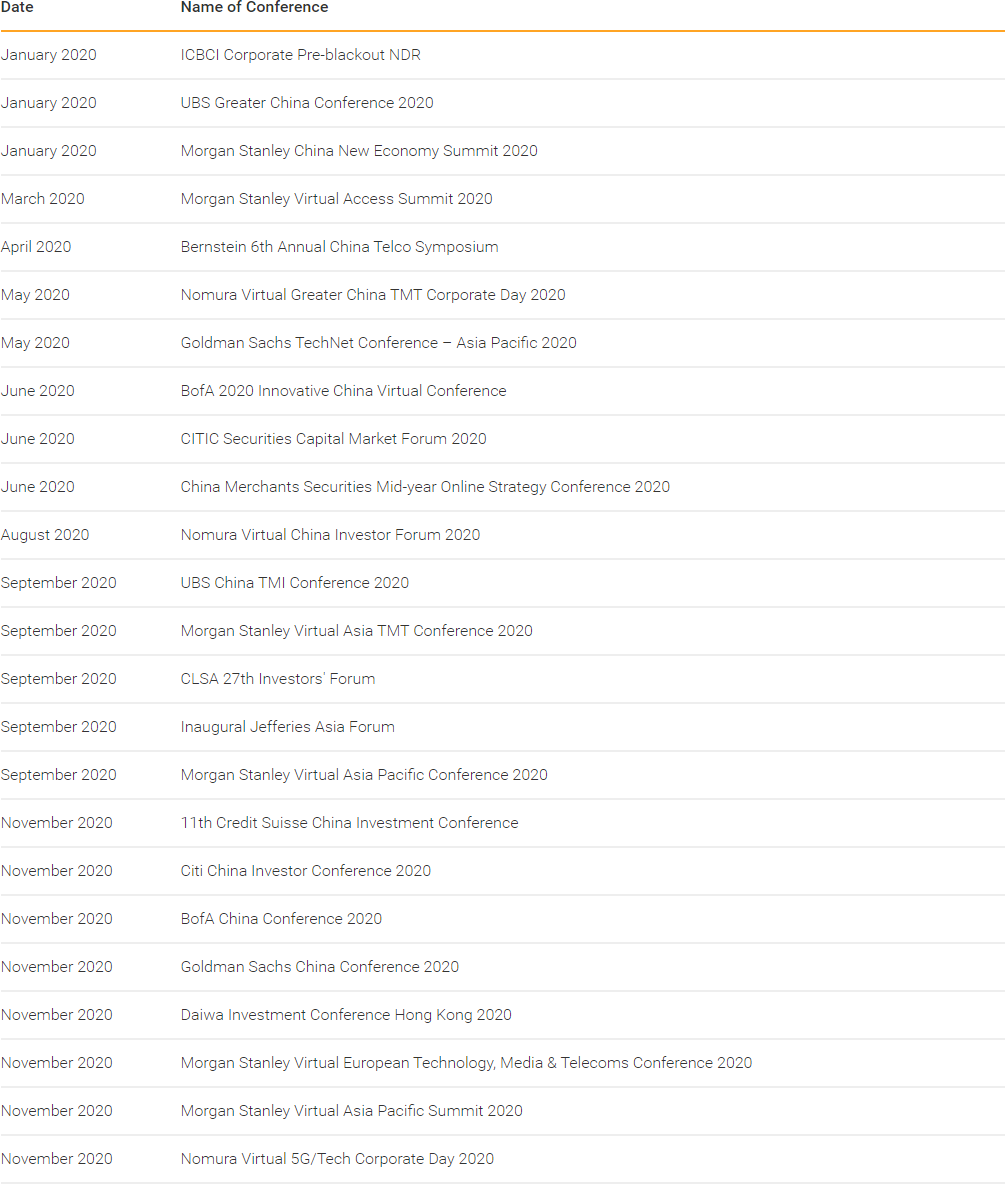
With an aim of strengthening communications with the capital market and enhancing transparency of information disclosure, the Company has provided quarterly disclosure of revenue, operating expenses, EBITDA, net profit figures and other key operational data, and monthly announcements of the number of access lines in service, mobile and wireline broadband subscribers. The Company attaches great importance to maintaining daily communication with shareholders, investors and analysts. In 2020, facing travel restriction brought by the COVID-19 Epidemic, the Company proactively participated in a number of investor conferences held by a number of major international investment banks around the globe through online meetings, which facilitated the communication with institutional investors.
In 2020, the Company attended the following investor conferences held by major international investment banks:
The Company's investor relations website (www.chinatelecom-h.com) not only serves as an important channel for the Company to disseminate press releases and corporate information to investors, media and the capital market, but also plays a significant role in the Company's valuation and our compliance with regulatory requirements for information disclosure. The Company launched a responsive website with the latest technology, which allows automatic adjustment to fit for different screen resolution and user interface, assuring the best browsing experience of website content with desktop computers, laptops or mobile devices. This allows investors, shareholders, reporters and the general public to browse the latest information on the Company's website with any device more easily and promptly anytime anywhere. The Company's website is equipped with a number of useful functions including interactive stock quote, interactive KPI, interactive FAQs, auto email alerts of investors activities, downloading to excel, RSS Feeds, self-selected items in investors briefcase, html version annual report, financial highlights, investor toolbar, historical stock quote, adding investor events to calendars, content sharing to social media, etc. In addition to setting up a dedicated investor relations enquiry line, a specialised appointment function to schedule a meeting with investor relations professionals was also launched on the Company's website, to promote direct and close communication between the Company and investors, as well as to increase transparency.
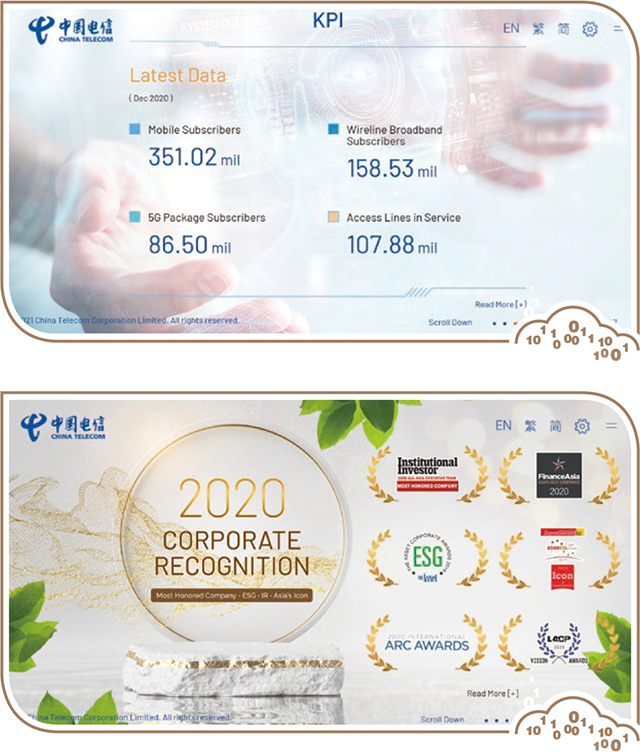
The Company also strives to enhance the disclosure quality and format of annual report. The Company further enhanced the transparency of disclosure in environmental, social and governance areas, by following the original guidelines of Environmental, Social and Governance Reporting Guide, Appendix 27 of the Listing Rules, to report the Company's achievements and key performance indicators on environmental protection, while also took initiative to comply with and adapt to the Listing Rules which were newly amended but not yet effective as well as the new guidelines of Environmental, Social and Governance Reporting Guide. For details, please refer to the Environmental, Social and Governance report of this Annual Report. Relevant indicators and data were analysed and assessed by independent third party to ensure compliance with relevant requirements.
The Company also actively seeks recommendations on how to improve the Company's annual report from shareholders through survey, and prepared and distributed the annual report in a more environmentally-friendly and cost-saving manner according to the recommendations received. Shareholders can ascertain their choice of receiving the annual reports and communications by electronic means, or receiving printed version in English and/or Chinese. The Company clearly and precisely delivered the messages about its strategies and goals in its 2019 Annual Report "Connecting Infinity, Empowering Future", so that shareholders and investors can easily understand the Company's development directions and focus. The print and online versions of 2019 Annual Report won a number of top accolades in international competitions, including being ranked No.7 of "Top 100 Reports Worldwide" (No.1 in Asia Pacific) in "LACP 2019 Vision Awards". They also received a number of platinum and gold awards in categories including telecommunications and technology industries, among others. In addition, the Company's print Annual Report has earned the gold award in "2020 International ARC Awards". These prestigious honours reflect the unanimous worldwide recognition towards China Telecom's tireless pursuit of excellence and globally leading performance on corporate governance and disclosure, on both conventional and digital channels.
The Company has always maintained a sound and effective information disclosure mechanism while keeping highly transparent communications with media, analysts and investors. Meanwhile, we attach great importance to the handling of inside information and have formulated rules on information disclosures and guidelines on inside information which encompass (including but not limited to) disclosure of sensitive information and rules on confidential information, identifying the scope of inside information, procedure and management guidelines on handling inside information. In general, the authorised speakers only clarify and explain on information that is available on the market, and avoid providing or divulging any unpublished inside information either as an individual or as a team. Before conducting any external interview, if the authorised speaker has any doubt about the information to be disclosed, he/she would seek verification from the relevant person or the person-in-charge of the relevant department, so as to determine if such information is accurate. In addition, discussions on the Company's key financial data or other financial indicators are avoided during the blackout periods.
Shareholders
Details of shareholders by class and shareholding structure can be referred to the Report of the Directors on pages 48 to 79 of this annual report.
Shareholders' Rights
Procedures for convening of an extraordinary general meeting or a class meeting
According to the Articles of Association, shareholders who request for the convening of an extraordinary general meeting or a class meeting shall comply with the following procedures:
2 or more shareholders holding in aggregate 10% or more of the shares carrying the right to vote at the meeting sought to be held shall sign one or more written requisitions in the same format and with the same content, stating the proposed matters to be discussed at the meeting, and requiring the Board to convene an extraordinary general meeting or a class meeting thereof. The Board shall convene an extraordinary general meeting within 2 months. If the Board fails to issue a notice of such a meeting within 30 days from the date of receipt of the requisitions, the shareholders who make the requisitions may themselves convene such a meeting (in a manner as similar as possible to the manner in which shareholders' meetings are convened by the Board) within 4 months from the date of receipt of the requisitions by the Board.
Procedures for proposing resolutions at the annual general meeting
When the Company convenes an annual general meeting, shareholders holding 3% or more of the total voting shares of the Company shall have the right to propose new motions in writing, and the Company shall place such proposed motions on the agenda for such annual general meeting if they are matters falling within the functions and powers of shareholders' meetings.
Process of forwarding shareholders' enquiries to the Board or requesting for convening of an extraordinary general meeting or a class meeting or proposing new motions
Shareholders may at any time send their enquiries, requests, proposals and concerns to the Board in writing through the Company Secretary and the Investor Relations Department.
To conform with the operation needs for corporate governance after the A Share Offering, the Company is required to amend the Articles of Association pursuant to the Securities Law and the Guidelines for the Articles of Association and other relevant laws and regulations. The relevant amendments (including those articles applicable to shareholders' rights) will be submitted for the approval by the shareholders of the Company at the extraordinary general meeting to be held on 9 April 2021. The new applicable Articles of Association will take effect from the date of the A Share Offering and Listing upon approval by the shareholders of the Company and fulfilment of relevant procedures of the regulatory authorities.
Please refer to the announcement published by the Company on 9 March 2021 and the relevant circular for further details.
The contact details of the Company Secretary are as follows:
The Company Secretary
China Telecom Corporation Limited
28th Floor, Everbright Centre,
108 Gloucester Road, Wanchai,
Hong Kong
Email: ir@chinatelecom-h.com
Tel No.: (852) 2877 9777
IR Enquiry: (852) 2582 0388
Fax No.: (852) 2877 0988
A dedicated "Investor" section is available on the Company's website (www.chinatelecom-h.com). There is a FAQ function in the "Investor" section designated to enable timely, effective and interactive communication between the Company, shareholders and investors. Company Secretary and the Investor Relations Department of the Company handle both telephone and written enquiries from shareholders of the Company from time to time. Shareholders' enquiries and concerns will be forwarded to the Board and/or the relevant Board Committees of the Company, where appropriate, which will answer the shareholders' questions. Information on the Company's website is updated regularly.
Amendments to Articles of Association
At the 2019 Annual General Meeting held on 26 May 2020, the shareholders approved the amendments to the Articles of Association. Pursuant to the requirements of regulatory authorities and the actual operational needs of the Company, the Company amended the relevant provisions of the Articles of Association regarding the scope of business to reflect the amendments to the contents of the operation permit for value-added telecommunications businesses. Pursuant to the requirements of "Reply of the State Council on the Adjustment of the Notice Period of the General Meeting and Other Matters Applicable to the Overseas Listed Companies (Guo Han [2019] No. 97)" to amend notice period, shareholders' proposal rights and convening procedures for general meetings applicable to joint stock companies incorporated in the PRC and listed overseas, the Company amended the relevant provisions in the Articles of Association regarding notice period, shareholders' proposal rights and convening procedures for the general meetings. Please refer to the announcement published by the Company on 24 March 2020 in relation to the proposed amendments to the Articles of Association and the circular published by the Company on 9 April 2020 for the details of the amendments.
Significant Differences Between the Corporate Governance Practices Followed by the Company and those Followed by Nyse Listed U.S. Companies
The Company was established in the PRC and is currently listed on the Hong Kong Stock Exchange and the NYSE. As a foreign private issuer in respect of its listing on the NYSE, the Company is not required to comply with all corporate governance rules of Section 303A of the NYSE Listed Company Manual. However, the Company is required to disclose the significant differences between the corporate governance practices of the Company and the listing standards followed by NYSE-listed U.S. companies.
Pursuant to the requirements of the NYSE Listed Company Manual, the Board of all NYSE-listed U.S. companies must be made up by a majority of Independent Directors. Under currently applicable PRC and Hong Kong laws and regulations, the Board is not required to be formed with a majority of Independent Directors. As a listed company on the Hong Kong Stock Exchange, the Company needs to comply with the Listing Rules. The Listing Rules require that at least one-third of the Board of a listed company in Hong Kong be Independent Non Executive Directors. As at the date of this report, the Board comprises 10 Directors, of which 4 are Independent Directors, making the number of Independent Directors exceeds one-third of the total number of Directors on the Board, in compliance with the requirements of the Listing Rules. These Independent Directors also satisfy the requirements on "independence" under the Listing Rules. However, the related standard set out in the Listing Rules is different from the requirements in Section 303A.02 of the NYSE Listed Company Manual.
Pursuant to the requirements of the NYSE Listed Company Manual, companies shall formulate separate corporate governance guidelines. Under the currently applicable PRC and Hong Kong laws and regulations, the Company is not required to formulate any guidelines for corporate governance; therefore, the Company has not formulated any separate corporate governance guidelines. However, the Company has implemented the code provisions under the Corporate Governance Code and Corporate Governance Report as set out in Appendix 14 of the Listing Rules for the financial year ended 31 December 2020.
Continuous Evolution of Corporate Governance
The Company continuously analyses the corporate governance development of international advanced enterprises and the investors' desires, constantly examines and strengthens the corporate governance measures and practice, and improves the current practices at the appropriate time; we strongly believe that by adhering to good corporate governance principles, and improving the transparency of operations, as well as the establishment of the effective accountability system, we can ensure the long-term stable development of the Company and seek sustainable returns for the shareholders and investors.
updated 1st December, 2021
| © Copyright 1996-2026 irasia.com Ltd. All rights reserved. |
|
DISCLAIMER: irasia.com Ltd makes no guarantee as to the accuracy or completeness of any
information provided on this website. Under no circumstances shall irasia.com Ltd be liable
for damages resulting from the use of the information provided on this website.
TRADEMARK & COPYRIGHT: All intellectual property rights subsisting in the contents of this website belong to irasia.com Ltd or have been lawfully licensed to irasia.com Ltd for use on this website. All rights under applicable laws are hereby reserved. Reproduction of this website in whole or in part without the express written permission of irasia.com Ltd is strictly prohibited. TERMS OF USE: Please read the Terms of Use governing the use of our website. |